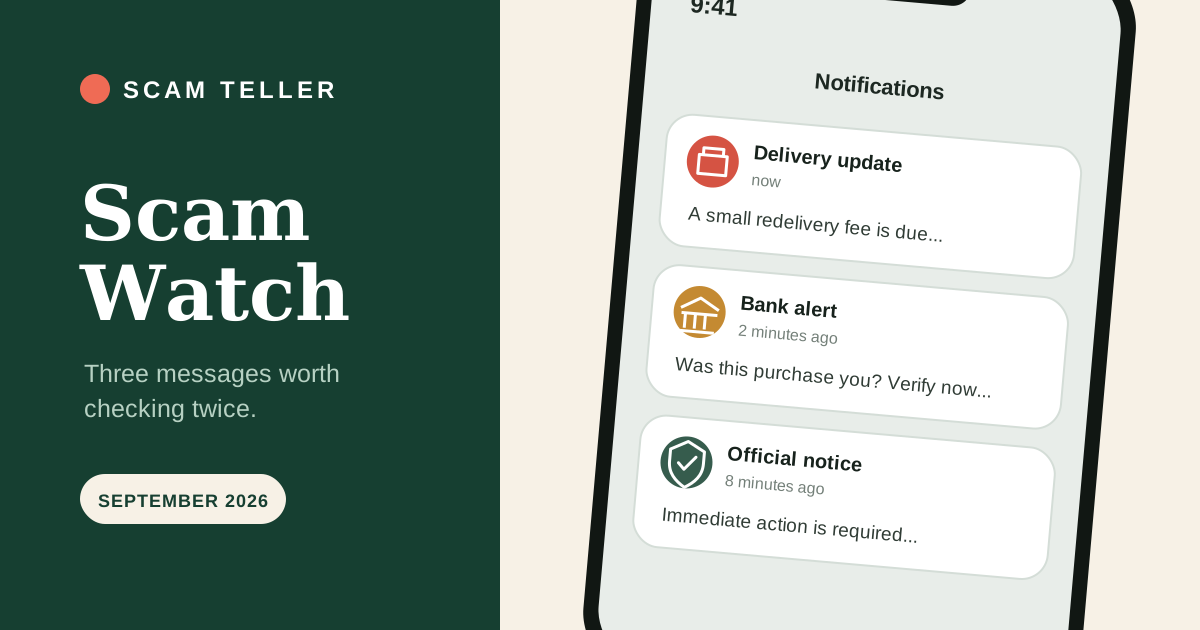
The most common scams targeting older adults in 2026 include fake delivery or toll texts, fake bank fraud alerts, and government impersonation. Each one creates urgency so the recipient acts before verifying the claim.
Based on the latest Federal Trade Commission complaint data and current FBI warnings, these are three of the most common scam patterns Americans should watch for in September 2026.
Fake delivery and unpaid toll texts
You receive a text claiming that a package could not be delivered, your address needs to be corrected, you owe a small unpaid toll, or a late fee will be added unless you pay immediately.
The message usually includes a link to a convincing copy of a postal service, delivery company, or toll agency website.
The amount requested may be only a few dollars. That small charge is meant to make clicking feel harmless. The fake website may then collect your credit card number, address, driver’s license information, or account password.
Postal service impersonation was the most frequently reported text scam in the FTC’s latest national analysis. The FTC has also warned consumers about widespread unpaid-toll texts. Read the FTC text scam report.
Do not click the link or reply. If you are expecting a package, open the retailer or delivery company’s official app yourself. For a toll notice, enter your state toll agency’s official website address manually.
Fake bank fraud alerts
These messages claim that your bank detected an unfamiliar purchase, a large transfer, a locked account, a new device, or a payment that needs your approval.
The message may ask you to click a link, reply YES or NO, call a phone number, or provide a verification code.
Some scams continue with a phone call from a supposed bank employee. The caller may know your name, bank, address, or recent personal details. Caller ID can also be manipulated to display a familiar number.
Fake bank alerts remain one of the most frequently reported forms of text-message fraud. Their effectiveness comes from creating urgency. People are more likely to act quickly when they believe their savings are at risk. See the FTC analysis.
Do not use the link or phone number in the message. Open your banking app directly or call the number printed on the back of your bank card. Never share a verification code with someone who contacts you.
Government and law-enforcement impersonation
A caller, text, or email claims to come from the FBI, Social Security Administration, Medicare, IRS, local police, or another government agency.
The scammer may claim there is a warrant for your arrest, your Social Security number was connected to a crime, your Medicare benefits are being suspended, you missed jury duty, or your money must be moved to a protected account.
The scammer may provide a name, badge number, case number, or official-looking document. Some threaten arrest or financial loss if you speak with anyone else.
The FBI issued a renewed warning on September 17, 2026. Nearly 61,000 government and law-enforcement impersonation complaints were submitted to the FBI between January 2025 and July 2026, with reported losses exceeding $1.6 billion. Read the FBI warning.
End the conversation without providing information or sending money. Government agencies do not demand immediate payment through cryptocurrency, wire transfers, gift cards, cash, or gold. Contact the agency using a phone number listed on its official .gov website.
A simple rule that prevents many scams
Treat unexpected links as unsafe until you verify them independently.
A message can look ordinary and still lead to a fake website. Do not rely on the logo, phone number, sender name, or information contained inside the message. Find the organization’s official website, app, or phone number yourself.
Check the message before you act.
Send the original text, a screenshot, a photo of physical mail, or a description of the situation. Get a clear explanation and a safer next step. No app required.
Research note: The FTC does not publish a real-time monthly ranking for September 2026. These selections combine its latest nationwide text-scam complaint rankings with federal warnings active as of September 22, 2026.